
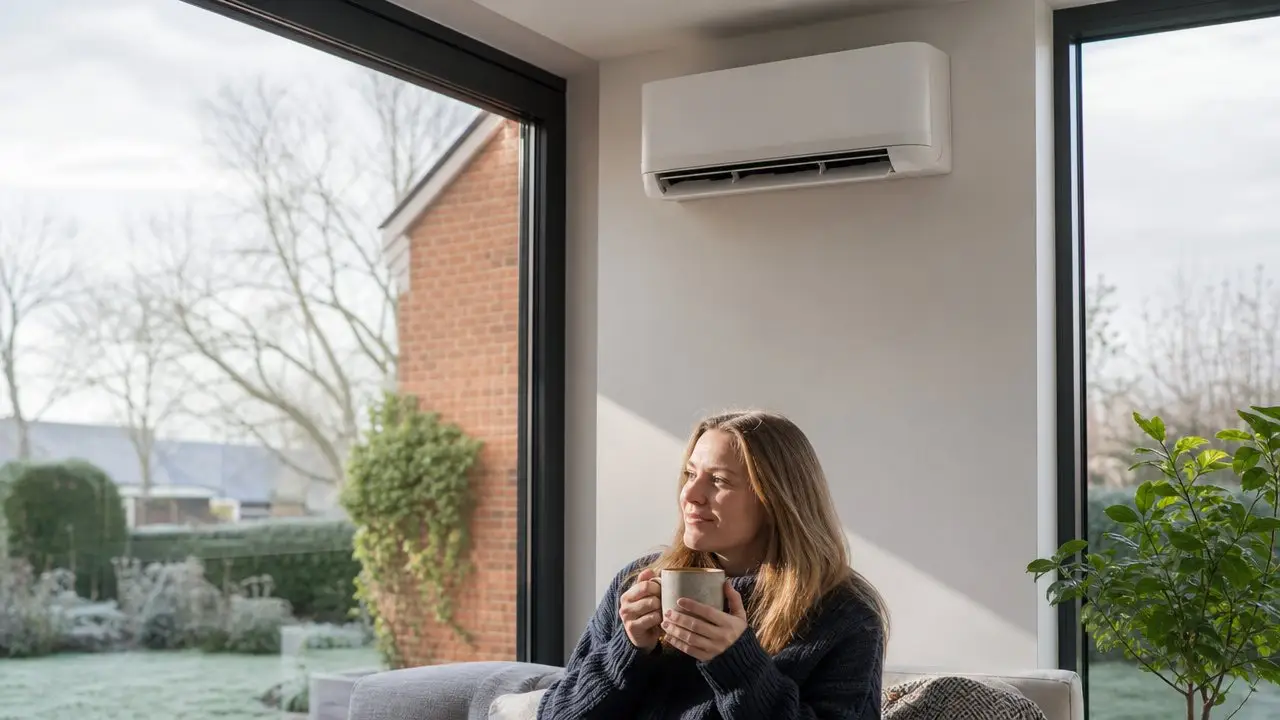
Yes. Most modern split air conditioning units are air-to-air heat pumps with a heating mode, and Worcester Bosch's Climate 3000i heats down to minus 15°C outside. On the current Ofgem price cap, each unit of heat usually costs a little less than from a gas boiler. But it heats the air in one room, not your radiators or hot water.
That last part matters more than the running cost. If you want one system that replaces your boiler, warms every room and runs the hot taps, air conditioning is not it, and we would rather tell you that now than after a survey. For whole-house heating and hot water, a well-serviced gas boiler or an air-to-water heat pump is still the usual answer.
Where air conditioning earns its place in winter is the room your central heating does badly, or the room you use while the rest of the house sits empty: the conservatory that is freezing by November, the loft conversion, the garden office, the spare bedroom you now work from all day. Heating that one room without firing up the whole house is where the numbers start to work.
How does air conditioning heat a room?
A split system has two parts: an outdoor unit on a wall or the ground, and an indoor unit, usually high on a wall, joined by a pair of refrigerant pipes. In summer it pulls heat out of the room and dumps it outside. In heating mode it runs the same cycle in reverse, drawing heat from the outside air and releasing it indoors through the fan.
That is why it is called an air-to-air heat pump. Even cold winter air holds some heat, and the electricity is used to move that heat rather than to make it. So one kilowatt hour (kWh) of electricity can deliver several kWh of warmth into the room, which a plug-in electric heater can never do.
There is no water involved, so it does nothing for your hot taps or shower.
Does it still work when it is freezing outside?
It does, within limits. Worcester Bosch's brochure for the Climate 3000i gives a heating operating range of minus 15°C to 24°C outside, which covers almost any winter night in Bedfordshire or Buckinghamshire.
What changes in the cold is efficiency. There is less heat in the air to collect, so the unit works harder for the same output. Grant, which makes heat pumps, says efficiency starts to fall once the outside air drops below about 3°C. On a frosty morning you get the warmth, but each unit of it costs a bit more.
You may also notice the indoor unit pause for a few minutes now and then. Ice builds up on the outdoor coil in cold, damp weather, and the unit runs a short defrost cycle to clear it. Grant describes this as a normal, automatic part of cold-weather running. If it happens every few minutes, or the outdoor unit is caked in ice that never clears, that is a fault worth getting checked.
This is why sizing matters. A unit chosen for a mild day can struggle on the coldest ones, so we size for the room, the windows and the walls.
What do the SCOP figures on the label mean?
COP, the coefficient of performance, is how many units of heat the system delivers for each unit of electricity at one set of test conditions. SCOP, the seasonal coefficient of performance, is the average across a whole heating season, with its cold spells and mild days. SCOP is the more useful number for a homeowner.
The energy label on a heating-capable air conditioner shows its heating performance for an average climate, and sometimes for warmer and colder ones too. For the Climate 3000i, Worcester Bosch lists SCOP figures between 4.0 and 4.2 for the average climate, depending on the model size. That is roughly four units of heat per unit of electricity, under test conditions.
Your own home will not match the test exactly. A draughty conservatory, a thermostat set high, or running it flat out on the coldest days all pull the real figure down. When you compare units, compare average-climate figures with each other, because the warmer-climate rating always looks better.
Is it cheaper to run than a gas boiler?
Usually a little, and the gap is smaller than many adverts suggest. Ofgem's price cap for 1 October to 31 December 2026 sets average direct debit unit rates of 26.32p per kWh for electricity and 7.97p per kWh for gas.
A new gas boiler in England must be at least 92% efficient under the government's Boiler Plus rules, so each kWh of heat from gas costs about 8.7p. Divide the electricity price by the air conditioning's efficiency and you get the cost of its heat:
- at a SCOP of 4, about 6.6p per kWh of heat
- at a real-world 3, about 8.8p, roughly level with gas
- on a freezing day when efficiency dips to 2.5, about 10.5p, dearer than gas
So on a good unit, sized properly and used sensibly, you might pay around a quarter less for each unit of heat than from a new boiler. As a rough illustration, 1,000 kWh of heat across a winter costs about £87 from gas and about £66 from an air conditioner averaging a SCOP of 4, at these prices. That is a useful saving on a room you use every day. It is not enough, on its own, to pay back the cost of an installation quickly.
Ofgem also notes that electricity carries no VAT from October 2026 to March 2027, so the gap may narrow when VAT returns. If you keep your gas boiler for hot water, you keep paying the gas standing charge too, so the saving comes from the unit rate alone.
The bigger saving often comes from heating less space. Warming one home office for the working day, instead of running the whole house's heating, is where people notice the difference. For cooling costs and how air conditioning compares with fans and plug-in heaters, see our guide to what air conditioning costs to run.
Can it replace my central heating?
In a typical three or four bedroom house, not on its own. Each indoor unit heats the room it is in, and warm air does not travel well through closed doors and up stairs. Heating a whole house means an indoor unit in most rooms, usually from a multi-split system with several indoor units on one or more outdoor units. MCS, which certifies heat pump installers, also points out that many air-to-air systems provide no hot water, so you would still need a boiler, a cylinder or another way to heat water.
It is a more realistic main heating source in smaller homes. The Energy Saving Trust notes that air-to-air heat pumps are more often used to heat smaller properties such as park homes and flats.
For most family homes, the sensible setup is both: the boiler runs the radiators and the hot water, and the air conditioning looks after one or two rooms that need it, plus cooling in summer.
Is there a grant for air-to-air heat pumps?
On paper, yes. The Boiler Upgrade Scheme in England and Wales was extended to air-to-air heat pumps by regulations that came into force on 28 April 2026. The Energy Saving Trust lists the grant at £2,500.
The conditions rule out most homes that just want one warmer room, though. The system has to replace your existing fossil fuel heating, not sit alongside it, and it has to be capable of meeting the whole home's space heating on its own. You need to own the property, and the installer must be certified by MCS. A single unit in the conservatory next to a working gas boiler will not qualify.
There is also a practical catch. MCS's own page on air-to-air heat pumps, last updated in July 2026, said it was still bringing them into the scheme and that no installers were yet certified to fit them. Until that changes, nobody can claim the voucher. Check the current position, and ask any installer whether they are MCS certified for air-to-air, before you count on the money.
When is air conditioning the wrong choice for heating?
Times we would steer you elsewhere:
- You want the whole house warm and hot water on tap from one system. Look at a new boiler or an air-to-water heat pump instead.
- Your radiators are cold at the bottom or slow to warm up. That is usually sludge in the system, and a clean or a powerflush (a high-flow clean of the pipes and radiators) may fix it for far less.
- The room loses heat faster than any sensible unit can put it in, like a single-glazed lean-to. Insulation or glazing may be the better first spend.
- You live in a listed building or a conservation area and an outdoor unit would face the street. It may need consent first, so read our guide to planning permission for air con.
Questions we get asked about heating with air conditioning
Can I run air conditioning and my gas central heating together?
Yes, and that is how most people use it. Turn the radiator down in the room the air conditioning heats, so the two are not working against each other. The boiler carries on heating the rest of the house and the water.
Can one unit heat the whole downstairs?
Only in an open-plan space. In a house with separate rooms and closed doors, the heat stays largely in the room the unit is in. Plan on one indoor unit for each room you want to heat properly.
What size unit do I need for heating?
It depends on the room's size, its windows and walls, and how cold it gets. Size it for the coldest days you want to be comfortable on, not the average day. That is what a home survey is for, and we will tell you if a room is not a good candidate.
Getting it right for your home
Air conditioning can heat a room through a British winter, and at today's prices each unit of heat usually costs a little less than gas. It works best as a partner to your central heating for the rooms that need it, not as a replacement for it.
If you have a conservatory, loft room or home office in mind, our engineers can look at the space and tell you honestly whether it suits. Get a free quote for home air conditioning from our Leighton Buzzard team, and if the boiler is carrying the rest of the house this winter, make sure it has had its annual service.