
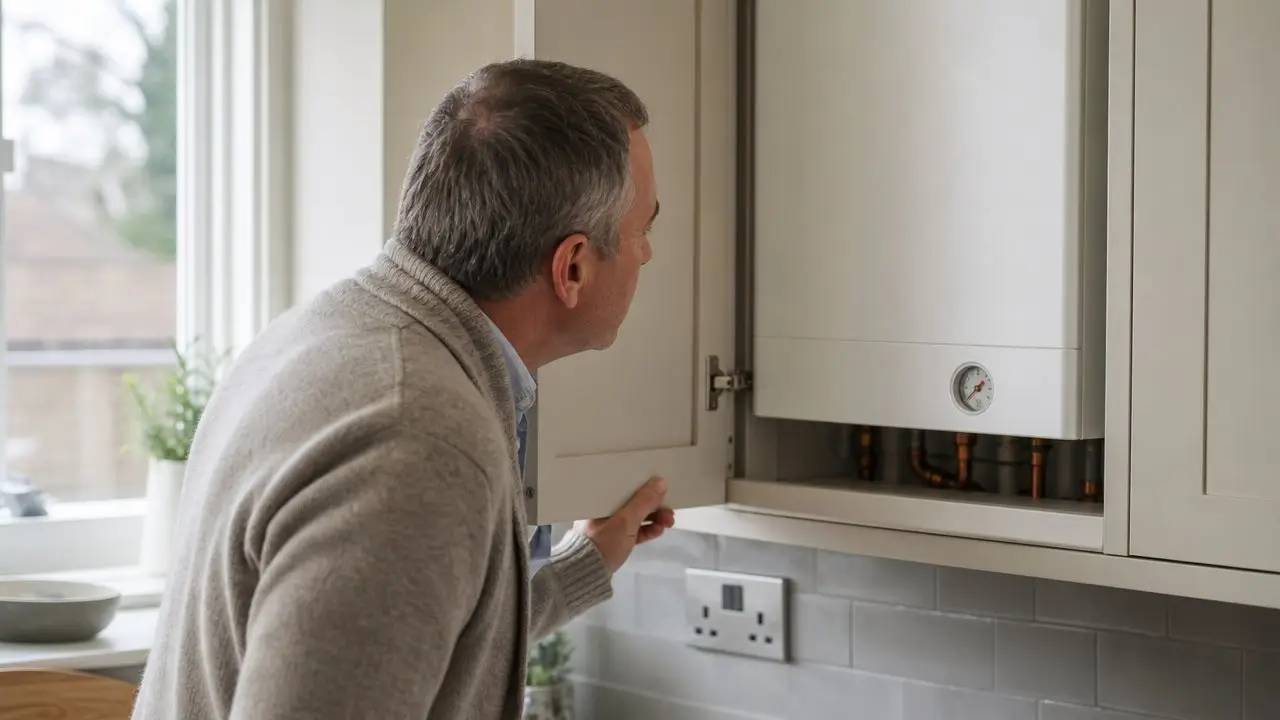
Your boiler pressure keeps dropping because water is escaping from the sealed heating system. The usual culprits are a small leak, a pressure relief valve letting water out, a tired expansion vessel, or air bled from the radiators. Topping up once or twice a year is normal. Every few weeks is not, and needs an engineer to find the cause.
Plenty of people who search this have nothing seriously wrong. If you bled the radiators last weekend and the gauge sank afterwards, top it up once and keep an eye on it. You do not need us for that. And a boiler that loses pressure is not, on its own, a reason to replace it. Most of the time it is a repair, and often a small one.
Where we come in is the slow, repeating drop: you top up, it holds for a week or two, then the needle is back in the red. That pattern has a cause worth finding before the boiler locks out on a cold morning.
What should the pressure gauge read?
Most modern boilers, combis included, run on a sealed system: a closed loop of water that the boiler pushes round your radiators under a little pressure. The gauge on the front of the boiler shows that pressure in bar.
Worcester Bosch's guidance is that, with the heating cold, the gauge should sit between 1 and 1.5 bar. When the boiler is running, the water expands and the reading rises, typically to around 1.5 bar or a little more. Vaillant gives much the same picture and says the reading should stay under 2.5 bar with the heating on.
So the cold reading is the one that matters: check it first thing, before the heating comes on. If it is under 1 bar, the system needs topping up. Worcester Bosch says that below 0.5 bar water has definitely been lost from the system, and many boilers will stop and show a low pressure fault at around that point.
Why does boiler pressure drop?
Pressure only falls if water leaves the system. These are the usual reasons, roughly from most to least likely.
You have recently bled the radiators
Bleeding lets trapped air out, and some water follows it. Both Baxi and British Gas point out that bleeding radiators lowers boiler pressure, so a top-up afterwards is expected. If the pressure then holds steady, that was the whole story.
A small leak somewhere on the system
This is the most likely cause of a repeating drop. It is rarely a burst pipe. More often it is a radiator valve weeping at the nut, a joint under the boiler, or a towel rail in the bathroom. Baxi makes a useful point here: on hot pipework, a small leak can evaporate before it ever drips, so look for rust, green or white crusting, and staining rather than puddles.
The harder ones are leaks you cannot see. Worcester Bosch's troubleshooting guide specifically mentions pipework under floors, and a leak under a floor or inside a wall can run for months before anyone notices damp.
The pressure relief valve is letting water out
Every sealed system has a pressure relief valve, a safety valve that opens if the pressure climbs too high. It discharges through a pipe, usually copper, that runs from the boiler to an outside wall. If that pipe is wet, dripping, or has left a stain down the brickwork, the valve has been opening. Worcester Bosch notes this can mean the valve is faulty, and Baxi adds that debris can stop it sealing properly.
The valve is often the messenger rather than the problem, though.
The expansion vessel has lost its charge
Water expands as it heats. The expansion vessel is a small tank, inside or next to the boiler, with an air cushion that soaks up that extra volume. Over time the air charge leaks away. With no cushion, the pressure shoots up every time the heating runs, the relief valve opens to protect the system and dumps water outside, and when everything cools down the pressure is lower than before.
The clue is on the gauge. Worcester Bosch says that if the pressure rises by more than 1 bar once the heating is hot, the expansion vessel may need repressurising, and that this is a job for a service engineer.
A fault inside the boiler
Less often, the leak is inside the casing itself: a seal, a pump, or the heat exchanger (the part that passes heat from the burner into your heating water). You may see drips under the boiler or water marks on the case. Do not take the cover off to look. As British Gas puts it, only a Gas Safe engineer should look inside a boiler.
How do I top up the pressure safely?
Repressurising is a homeowner job on most boilers, and your boiler's user manual is the place to start. In broad terms you let mains water into the system through a filling link or filling loop until the cold gauge reads about 1 to 1.5 bar, then close it again. Worcester boilers have a key or a blue lever under the boiler rather than a hose, and our guide to Worcester Bosch error codes walks through both, step by step.
A few things catch people out:
- Top up with the heating off and the system cold, or you will be reading a warm, inflated figure.
- Go slowly. Overfill it and the gauge creeps into the red, around 2.75 bar on a Worcester gauge, which can make the relief valve open. Bleeding a radiator brings it back down.
- If you have an external filling loop (a silver braided hose under the boiler), make sure both valves are fully closed afterwards. Water industry guidance from Water Regs UK says it is good practice to disconnect and remove the hose when it is not in use.
- Press reset only once if the boiler has locked out. If it will not restart, leave it and call an engineer.
If you get no pressure at all from the mains, the problem may be your water supply rather than the boiler. Our article on low water pressure at the taps covers that, and it is a different problem from the one here.
What can I check myself before calling anyone?
You can narrow things down a lot without touching anything you should not:
- Note the cold reading each morning for a week, and when you topped up. That gives an engineer the rate of loss.
- Look at every radiator valve, the towel rails, and any pipework you can see, especially under the boiler. Run a dry tissue round the joints.
- Go outside and find the relief valve pipe. Is it wet, dripping, or stained underneath?
- Watch the gauge as the heating warms up from cold. A big jump points to the expansion vessel.
Write down what you find. It saves time on the visit.
When is it a job for an engineer?
Worcester Bosch's own advice is that pressure normally needs topping up once or twice a year, and that if you are having to do it much more often you should contact your installer. That is our rule of thumb too. Call a Gas Safe registered engineer if:
- you are topping up every few weeks, or the drop is getting faster
- the relief valve pipe outside is dripping or wet
- the pressure jumps by more than 1 bar when the heating warms up
- you can see water under or around the boiler
- the boiler keeps locking out on low pressure even after a top-up
Keeping on topping up is not a fix. It hides the cause, and if that cause is a hidden leak, the water is going somewhere: into a floor void, a ceiling, or a wall.
What affects the cost of fixing it?
We will not quote a figure here, because the price depends on what we find, and we tell you that before any work starts. What moves it is fairly predictable:
- Where the leak is. A weeping radiator valve you can see is a quick job. A leak under a floor means lifting boards to find it.
- Which part has failed. Recharging an expansion vessel with air is a simpler job than replacing the vessel, and on some boilers the vessel sits deep inside the casing.
- The boiler's age. On an older boiler, parts can be harder to get. If it is also breaking down for other reasons, we will tell you plainly whether a repair still makes sense. Our article on signs your boiler might need repairing or replacing explains how we weigh that up.
- Guarantee cover. If your boiler is still within its manufacturer's guarantee, check the terms before paying for a repair, as an internal fault may be covered.
Questions we get asked about boiler pressure
Is it dangerous if my boiler pressure is low?
Low pressure is not a gas safety issue in itself. The boiler is designed to stop when the pressure is too low, which is why you lose heating and hot water. The bigger risk is water damage from a leak nobody has found.
Why does my pressure go up when the heating is on?
Hot water takes up more room than cold, so a rise is normal. Up to around 1.5 bar or a little over is fine. A rise of more than 1 bar, or a reading heading towards the red, points to the expansion vessel.
Can I still use my boiler while it is losing pressure?
Yes, as long as you keep the cold pressure in the normal range and there is no water coming from the boiler itself. If you see water inside or under the casing, switch it off and call an engineer.
Will an annual service catch this?
Often, yes. A service is a good time for an engineer to check the expansion vessel charge and look for early signs of leaks around the boiler. You can see what is involved in our guide to what happens during a boiler service.
Getting it sorted
A boiler that needs topping up once or twice a year is behaving normally. One that needs it every few weeks is losing water somewhere, and the cause is almost always findable. If you are in Leighton Buzzard, Milton Keynes, Bedford or the towns around, our Gas Safe registered engineers will track down the cause, explain what they found, and give you the cost before any work starts. Book a boiler repair and tell us what the gauge has been doing.